


INTRODUCTION
If you already managed a big ERP implementation, then you are already aware of this fact:
The software issue isn’t the big problem, but the real challenge is how the organization prepares for it.
I also recall having discussed this with a senior CFO of Pune, who informed me that they had believed that 80 percent of the work was done by purchasing the ERP. Turns out, it was only 20%.”
I have been hearing that over the past ten years. This is the case whether it is a medium-size manufacturing enterprise in Coimbatore or a rapidly expanding D2C brand in Gurgaon, but the trend is identical:
Firms desire ERP deliverables, but not ERP discipline.
One of the principles, which have not changed with time, in my experience of helping clients in India that have moved away with legacy systems to the modern ERP software is as follows:
RP implementation is like constructing a skyscraper, and if its foundation (data) is the weak point, the entire system will become insecure.
You can get the best architects, engineers and materials but provide your soil and foundation had not been prepared properly, then everything on top of this is in danger.
ERP is no different.
And that is why a gradual approach is not only a good practice –
it is the surest way to go to CFOs and IT Heads who need stable results.
These experiences consistently prove that following ERP best practices and adopting a phased approach to ERP implementation provides organizations with far greater stability than a hasty deployment.
Reason a Staged ERP Implementation Process is Good especially in India.
In India, the organisations do not work in an ideal structured environment. We deal with realities like:
- Teams with mixed digital literacy
- Several legacy (Tally, spreadsheets, custom tools) systems operating at the same time
- Compliance-heavy processes
- Scales ups and shifting operational requirements
- Bureaucracy cross-functional and vendor dependencies
Attempt to push a big bang go-live and the system might go live… but the people will not.
Staged implementation allows the recognition of the complexity of Indian businesses, the human learning curve, and the creation of ERP strength in a layer-by-layer manner. This is stratified to be a worldly measure of ERP implementation when real ground-level complexity in India must be adhered to by existing ERP software.
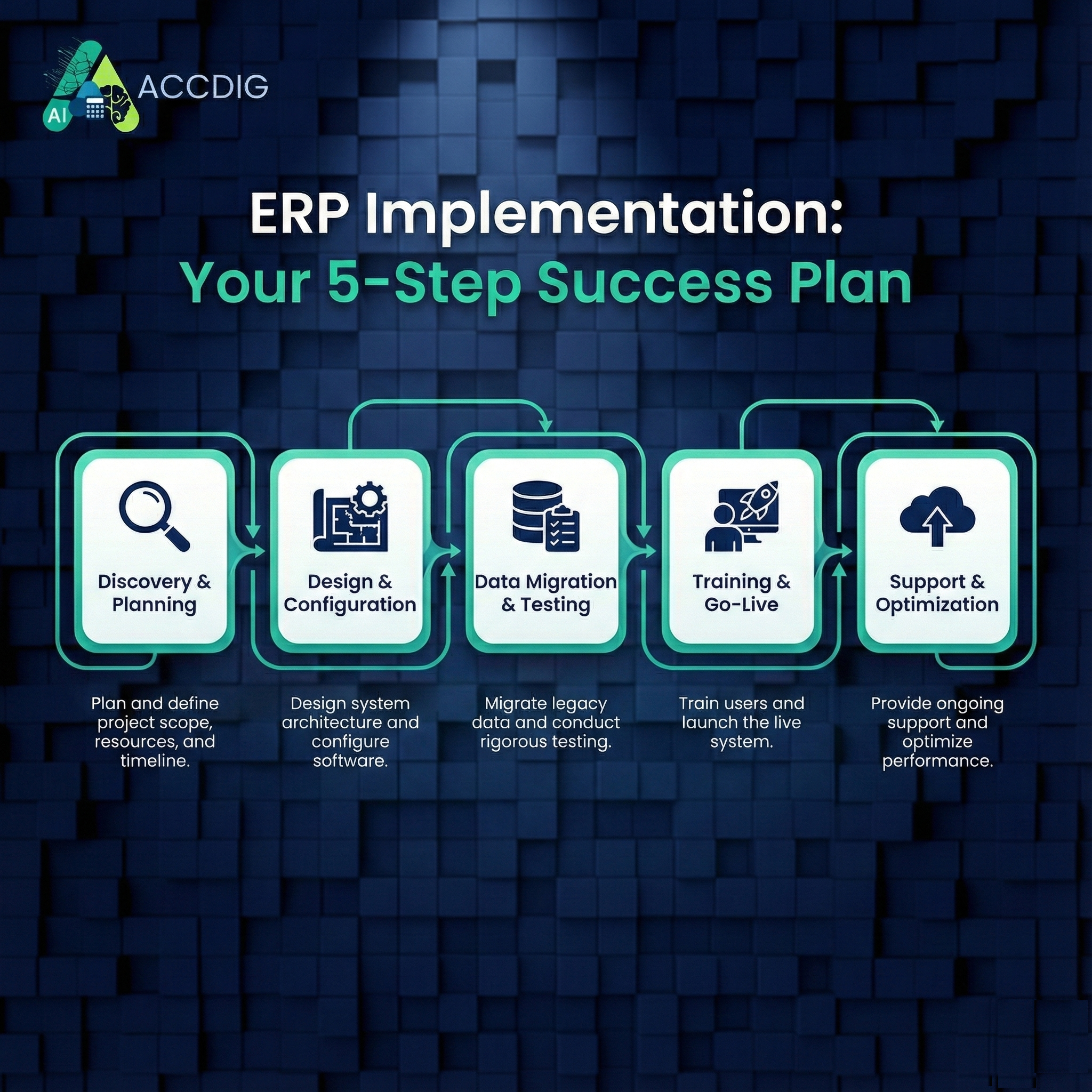
I have five steps to the CFOs and IT Leaders that I usually suggest, the same plan my team members and myself use when leading clients.

Phase 1 – Business Process Mapping and ERP Readiness Test.
There is an important question to be answered before touching data, modules and configurations:
Have we operational ready for ERP?
I have observed organisations moving straight to configuration due to slick dashboards demonstrated by the ERP vendor. However, ERP is not a dashboard, it is an underpinning.
What this phase involves:
- Knowledge of existing operations in finance, Hr, procurement, inventory, CRM, etc.
- Determining the bottlenecks, redundancies, and manual dependencies.
- Mapping all processes to the ERP module that will be used to support it.
- Evaluating information cleanliness, employee preparedness and adherence.
- Documenting the “As-Is” vs. “To-Be” processes.
A quick Indian example:
One of the textile exporters based in Surat thought that their purchase process was easy.
When mapped, we discovered:
- 3 different approval styles
- 2 offline Excel trackers
- GRN’s were being prepared after invoicing
- Master data on vendors was replicated 11 times.
This was not an ERP problem, but rather a process discipline problem.
Their subsequent conversion to ERP was a lot easier and their implementation became a lot more precise by sealing these gaps at the outset.
The other question that most CFOs ask is, “How long does ERP implementation take?” In fact, the solution is in how seriously the organisation is taking the mapping and preparedness at the initial stages.
Phase 2 Data Cleaning, Migration (The Foundation Phase).
It is the least anticipated phase among the CFOs.
The majority of organisations have an assumption that data migration involves the transfer of data in old systems and transfer it into new systems.
But ERP migration is actually forensic.
In my experience, about a large share of ERP failures in India are due to poor data preparation.
Why data cleaning matters:
ERP requires relational integrity. Most of ERP best practices models revolve around the fact that, in either terms of size or industry, data integrity forms a non-negotiable sector of ERP implementation.
In case your product codes are copied, you have different vendor names, or different tax category, the ERP will impose regulations that your previous system never was conscious of.
What this phase includes:
- Cleaning of customer master, vendor master, SKU master, CHART of accounts master, BOM master and employee master data.
- Removing duplicates.
- Naming conventions Standardization.
- Mapping tax structures (especially GST complexities).
- Balance Reconciling opening balances and stock quantities.
- Formulation of migration templates.
- Test migration runs.
Minimum recommended duration:
At least 3 months.
(Under this, the organisation must take into account the unforeseen expenses that may arise during the project or programme’s execution. Below this, the organisation would need to consider the unexpected costs that could be incurred in the implementation of the project or programme.)
An analogy- Skyscraper:
Suppose we build a sky-scraper, and fill up the frame-work with raw sand, rubble and rubble. The building can be elevated, yet each story will be more shaky.
This is what bad data does to ERP.
Phase 3 -Configuration, Customisation and User Acceptance Testing.
This is where the ERP start to emerge.
However, here is one thing that most CFOs fail to consider:
ERP vendors are software configured, and the fit can only be proven by the organisation.
Configuration Scope Process used:
- The establishment of modules (Finance, HR, SCM, CRM, Manufacturing, etc.)
- Approving workflows definition.
- Mapping roles & permissions
- Integrating with the existing tools (HRMS, CRM, POS, bank feeds, GST tools)
- Developing dashboards and MIS templates
- Little customisation (only where necessary)
Do not leap towards customisation
One of the errors that I observe is organisations designing the ERP to fit their old processes. This would nullify the whole idea of ERP.
Customise only when:
- Compliance demands it
- Business model demands it
- The present efficiency is greater than the maintenance expenses in the future
User Acceptance Testing (UAT)
In UAT, real people working in real workflows using real data.
This stage reveals:
- Broken workflows
- Missing steps
- Incorrect configurations
- Edge cases
- Training gaps
An effective UAT will save months of post go-live firefighting.
At this stage, companies will know the final cause as to why experienced consultants are demanding ERP best practices as opposed to tricks and over-customisation.
Phase 4 – Staff Training, Change Management and Soft Launch.
Implementing ERP software is much easier than getting people to use it
Confidence level in the use of ERP is directly proportional to its success.
Training plan should include:
- Hands-on sessions
- Sandbox learning environments.
- Role-based learning
- Short videos or SOPs
- An all-star user model (power users in every department)
Change Management within Indian Situation
Here, employees tend to be afraid of ERP as they consider it to be more surveillance or change of role.
These methods have worked well to me as a CA/CPA working with teams:
- Timely and effective communication
- Demonstrate how ERP eases their work
- Engage senior management physically
- Celebrate early wins
- Make people not victims of the process but part of it
And this is where the modern day ERP software practically meets the actual user behaviour in life and therefore formal training is required.
Soft Launch (Mini Go-Live)
The soft launch is a simulation of actual operations before the actual Go-Live using chosen teams.
This instills confidence and brings out gaps before the whole organisation is hit.
In almost every project, a phased approach for ERP implementation results in higher adoption levels and fewer post–go live escalations.
Recommended timeline:
Minimum of 4-6 weeks pre Go-Live training.
Phase 5 – Go-Live, After the launch audit/Constant optimization.
It is at this point that most organisations take a deep breath – but in fact it is at this point that work actually starts.
It is also at this stage that CFOs are back to the argument, How long does ERP implementation take? It is the reality that takes the reality to witness the period of stability.
Go-Live is not the end game, rather it is the beginning of ERP maturity.
The organisations that adopt in Globle ERP best practices at this level expand faster and their operations undergo very minimal disruptions.
The general activities that usually happen during the first 90 days include:
- Daily issue tracking
- Adjusting workflows
- Fixing data mismatches
- Additional staff training
- Reviewing KPIs & MIS reports
- Strengthening controls
Post-launch audit includes:
- Checks of accuracy of transactions
- Role permission reviews
- Rechecking of master data
- Conformity (in particular, GST, TDS, payroll)
- System performance review
- Future phase gap analysis
Process Optimization
Upon the attainment of transactional stability, CFOs need to slowly transition to:
- Robotization of repetitive procedures
- Advanced analytics
- Budgeting modules
- Cost-centre optimisation
- RPA-led workflows
- AI-assisted reporting
ERP is not a tool — it’s an dynamics ecosystem.
A Micro Case Study (Anonymous) (Real-World).
An Indian mid-sized manufacturing company of auto parts based in Pune had decided to switch Tally + Excel to a cloud ERP.
They prepared and rushed through data and did not have structured training.
Outcome?
- Wrong opening balances
- Inventory mismatch of 18%
- Sales orders were not mapped correctly to the dispatch.
- GST mismatches
- Employees who fail to embrace new working procedures
They made a call 60 days after Go-Live.
We took 10 weeks to audit data after release of the new system and reconfigured and retrained users.
Their efficiency in operations went up by 25% in 3 months.
Lesson:
Failing ERP is not a software failure –
it is most of the time a failure of preparation.
The case substantiates one universal truth, i.e. that unless discipline is executed in implementation of ERP software, the best ERP software will not yield significant outcomes.
Common Myths CFOs & IT Heads Often Believe
Myth 1: “The ERP will correct our business ills.”
ERP exposes problems. It doesn’t fix them. Disciplined process design only is done.
Myth 2: “We can go live in 2-3 months.”
In India, this is hardly healthy unless the organisation is very small.
Myth 3: “The more it is customised the better the system.”
Wrong.
Increased customisation = increased maintenance + risk.
This is why experienced teams prefer a phased approach for ERP implementation over large, hurried rollouts.
Myth 4: “ERP is a one-time project.”
It is a constantly developing capabilities.
FAQs
1. How long does ERP implementation take?
In the case of mid-sized Indian companies, a period of 6-12 months is feasible.
When evaluating how long ERP implementation takes, factors like team readiness, data quality, and module complexity become major contributors.
2. What is the most time consuming phase?
Data Cleaning & Migration and Training —
They are both preliminary and may not be hurried.
The majority of the ERP best practices mention that the phases cannot be haste rushed to risk structural instability of the system under the long-run.
3. Should we run old systems in parallel?
Soft parallel run during the soft launch are fine; The use of long overlaps is confusing.
4. Is ERP implementation to be led by CFOs or IT Heads?
Both.
ERP is not an IT-led but business-led.
5. Which is the largest predictor of ERP success?
Organisational discipline.
Technology is secondary.
Final Takeaway for CFOs & IT Heads
ERP implementation is overwhelming, but it is only that way when it is not done in a structured manner.
The incremental strategy provides your organisation with the transparency, discipline and space to embrace ERP in a sustainable manner.
With the right investments in data, people, and processes, technology almost always works.
CONCLUSION
ERP Implementation is not an upgrade of IT.
It is a business transformation.
And as in erecting a skyscraper, the basis is everything.
Those who adopt a step-by-step approach CFOs and IT Leaders who think step-by-step –
Data -Configuration – Training -Go Live – Optimization –
don’t just launch ERP.
They provide a competitive advantage that grows over time.
Those organisations, which consider ERP as a strategic programme with the support of ERP best practice, clean data and strategized governance, always perform better compared to those, which rush.
Accdig team can assist you on ERP transition, or provide a professional audit of your existing implementation.
We assist business in India create ERP platforms that are stable, scalable and future-ready.
🚀 Ready for exclusive tips? Follow Accdig on Facebook, Instagram, and LinkedIn to stay ahead—don’t miss out! 📱✨

