


Sameer, let’s talk.
You are monitoring your MRR, your CAC, your LTV… you are a founder, you are a data-breathing person. Do you follow your advance tax liability?
In case you have just flinched, it is in your favor.
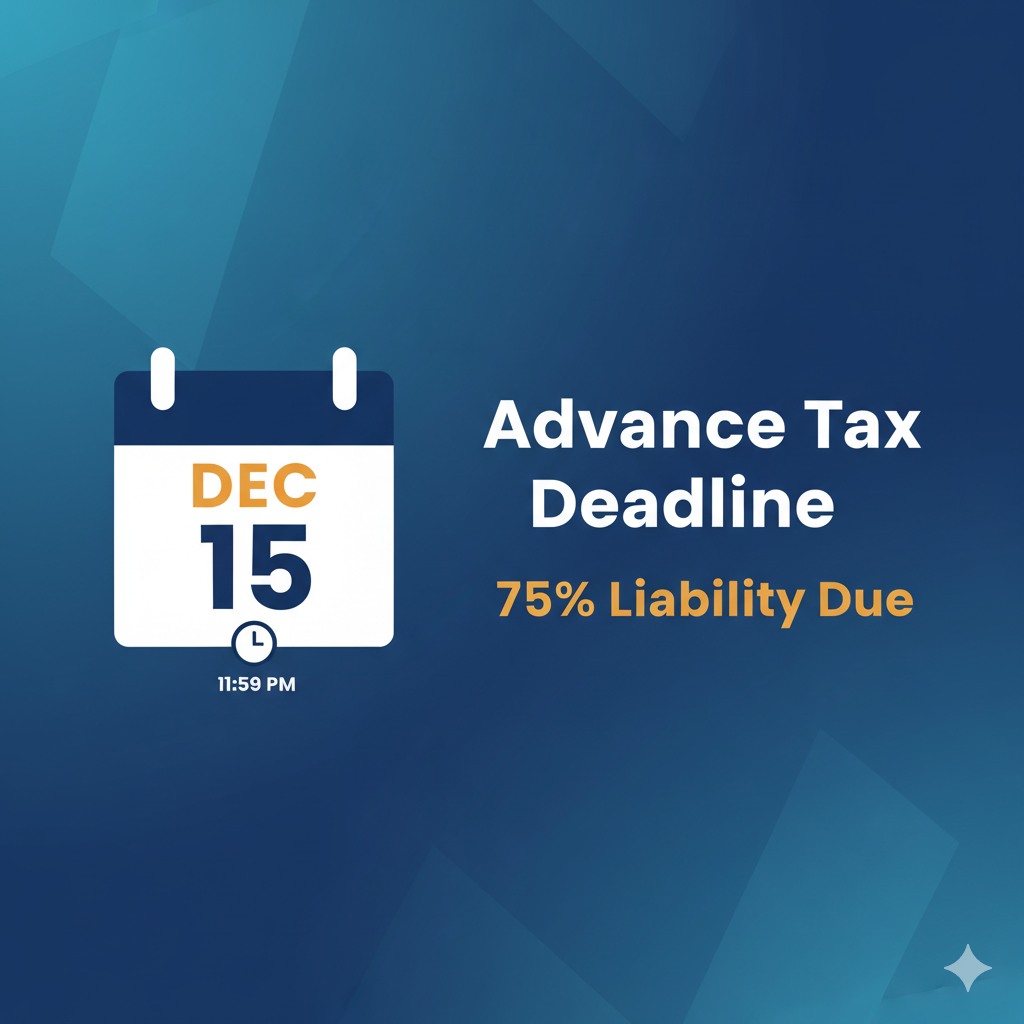
Well, only a few weeks before December 15 th, and this is not a normal date on the calendar. And this is the last date of the third, and most important, instalment of your Advance Tax, to any business owner or professional in India.
My name is [Your Name/Firm Name] and I am a Chartered Accountant. I do not file returns, I work with founders such as you to ensure that your bottom line is not leaking cash that you are even unaware of. And I will tell you: not paying your advance tax is one of the largest unnecessary cash leaks that I observe.
I hear founders say it, “I will get everything all fixed in March.
Such an error is quite costly.
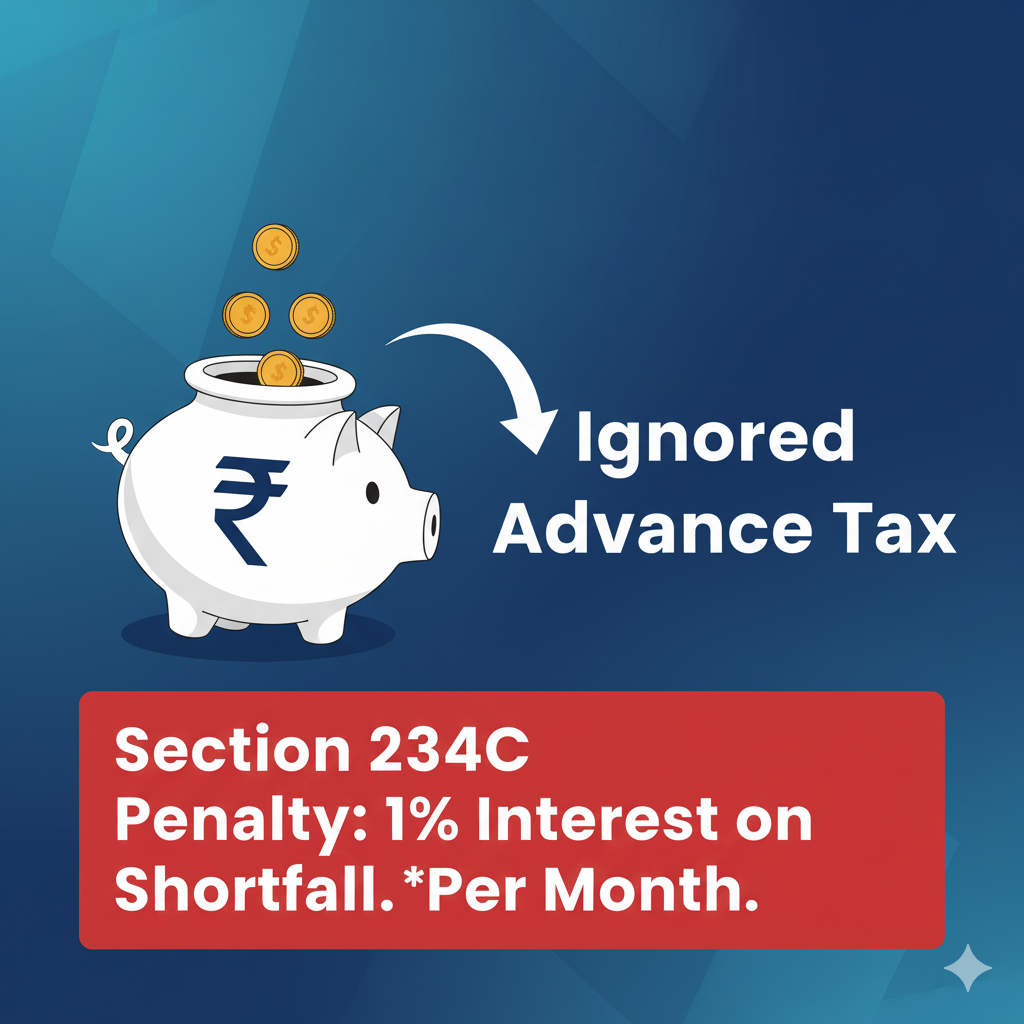
This is no little compliance penalty. That refers to Section 234C which imposes an interest of 1 percent monthly on the balance. It is an involuntary, silent, compulsory profit-sharing with the government.
This handbook is your 10 minutes intervention. I will provide you with the white and black, 3-step checklist of where you are and the reason behind it all. No jargon, just the facts.
What is Advance Tax and Why Should a Founder Like You?
To begin with, we must dispel one of the myths. Advance Tax is neither a founder tax nor penalty.
It is just the Pay-As-You-Earn system of the Income Tax department.
Consider it: Your employees make payment of tax on a monthly basis through TDS. Why do you as the business owner who is making profits get to wait 12 months? The government desires to have its cash flow, as you desire yours.
This is the general rule, then, that where your total tax payable during the financial year (tax after deduction of TDS) is likely to amount to [?]10,000 or above, you will have to pay tax in installment.
The “But I’m Not Profitable!” Trap
This happens to be the first thing that I hear founders of startups say.
My company is consuming cash we are not profitable.
I hear you. but the taxman notices something you may be missing:
- Interest Income: You did a seed round. It is in a Fixed Deposit or liquid fund, right [?]5 crore. Such interest is taxable income.
- You, the Founder: Do you receive a salary? Do you invest on a personal basis? Sold any ESOPs on a former employment? That income counts.
- Your Company’s Books: Does your company (as a Private Limited entity) make net profit, but what about your liability? Or does your startup Proprietorship or LLP? The rules are different.
In the case of Advance Tax in India, you may refer to you as an individual, or as a proprietor or to your company of Private Limited. Everyone is liable. Getting a clear picture of Advance Tax for Startups is crucial, regardless of immediate profitability.
The Deadline You Can No Longer Ignore: The December 15th, 2025 Mandate.
The official Advance Tax calendar will be as given in this Financial Year (2025- 26 ). This should be on your wall.
| Installment | Due Date | Percentage of Total Tax to be Paid (Cumulative) |
| 1st Installment | By June 15, 2025 | At least 15% |
| 2nd Installment | By September 15, 2025 | At least 45% |
| 3rd Installment | By December 15, 2025 | At least 75% |
| 4th Installment | By March 15, 2026 | At least 100% |
This explains why the deadline of December 15 th is very crucial.
This explains why the Advance Tax Due Date December 15th is very crucial. At this date you are required to make 75% of the total amount of your year end tax.
This is the big one. This is the key control point of the government. And this is your last actual chance to pay up on the first two instalments (15 per cent and 45 per cent) in case you have been underpaying or not paying them at all.
If you don’t? You get back into the penalty box.
The Real Cost of the Section 234C Penalty: The Section 234C Penalty.
When founders are introduced to penalty, they assume a flat fee. [?]5,000. [?]10,000.
Section 234C isn’t a penalty. It’s interest. And it’s far worse.
It consists of 1 per cent of easy interest on an unpaid balance per month (or part month) with respect to that particular quarterly due date.
Let me make this real.
A Quick Case Study (The names are not provided):
I began my work with the startup of B2B SaaS called Innovatech Solutions last year. The founder, “Rohan” was a genius. His third quarter had been a good one as he had two enterprise deals.
He missed his instalment in June and September, with the thought, I will pay a bumper in March.
This amounted to ₹20 lakhs of tax due to him in a year.
- By Sep 15: He should have paid ₹9 lakhs (45%). He paid ₹0.
- Shortfall: ₹9 lakhs.
- Section 234C Interest: 1% on ₹9 lakhs for 3 months (Oct, Nov, Dec) = ₹27,000
- By Dec 15: He should have paid ₹15 lakhs (75%). He paid ₹0.
- Shortfall: ₹15 lakhs.
- Section 234C Interest: 1% on ₹15 lakhs for 3 months (Jan, Feb, Mar) = ₹45,000
And this was (simplified calculation) a simplified calculation.
Rohan was made to write a cheque of more than ₹72,000 (and other interest under Section 234B) over nothing. That was a new server. It was an advertising campaign. Gone.
He wasn’t evading tax. He was just late. And late is a four letter word in conformity.
This is not a cost of doing business. It’s a failure of process. It is an entirely unnecessary cash burn. This is the punitive side of Section 234C.
How to Calculate Advance Tax: A 3-Step Checklist for Founders
Well, that is enough of the warning. Here’s the action plan. Grab your coffee. This is the how to compute advance tax part.
You must do this now, not on the 14 th of December.
Step 1: Please estimate your total taxable income during the entire year (FY 2025-26).
This is the most difficult one in the case of a dynamic start up. You are not an accountant, you are a dreamer. To be this you must be a realist.
Consider your P&L between April 1 and present (e.g. November 30).
- What’s your profit so far?
- At this point, estimate your revenue and expenditure in the next four months (Dec, Jan, Feb, Mar).
- Don’t forget other income!
- Bank accounts and FDs interest (this one is huge)
- Capital Gains (Sold any shares, mutual funds or property?)
- Rental income?
- Any additional personal income (when it is an individual filing)?
Add it all up. Your Gross Income is the Estimated Gross Income.
Out of this deduct your deductions:
- Company costs (salaries, rent, marketing, etc.)
- Amortization of your property (laptops, office furniture).
- In the case of individuals: Your 80C, 80D, etc. (PPF, insurance, etc.).
Your Remaining Estimated Net Taxable Income.
Step 2: Compute Your combined income on that income in terms of tax liability.
Now put the tax slabs on the Step 1 number.
- For your Pvt. Ltd. Company: Do you run on the new 22% regime (Section 115BAA)? Or the old 30%? Most new companies are on the 22% + surcharge + cess.
- For You (Individual/Proprietor): Are You New Regime or Old Regime?
That is what you get as your Gross Tax Liability.
IMPORTANT: Out of this figure, deduct all TDS which has been previously deducted to your clients or which will be deducted during the remaining part of the year.
The last figure is your Estimated Net Tax Liability in your Year.
Let’s say this number is ₹5,00,000.
Step 3: Pay the Right Percentage on instalment.
This is the easy part.
- Your Target for Dec 15: 75% of your total liability.
- ₹5,00,000 * 75% = ₹3,75,000
- Amount to Pay Now: Subtract what you’ve already paid.
- ₹3,75,000 – (Amount paid in June + Amount paid in September)
That’s it. That’s the number.
That is the amount you should be adding to Challan 280 on the Income Tax e-filing portal by the 11:59 PM deadline on the 15 th of December.
The “Presumptive” Trap: A Caution on Freelancers, Consultants and Small Agencies.
This is a high-alert section. A large number of the founders are high-earning consultants, developers or designers who operate as proprietorship.
It is possible that you are on the Presumptive Taxation scheme.
- Section 44AD: For businesses.
- Section 44ADA: In case of professionals (doctors, lawyers, CAs, architects, technical consultants, designers).
Here there is an enormous and general misunderstanding.
- Unluckily, you are a Professional under Section 44ADA. The quarterly deadlines do not exist in your case. Any amount of advance tax can be paid in a single instalment before March 15, 2026.
- This is out of luck to you in case you are a Business under Section 44AD. You are required to pay on the quarterly instalment plan (15, 45, 75, 100).
I have witnessed the wrongdoings of thousands of developers and agency owners (who fall under 44AD) being wrong. They believe that they can hold on until March. They can’t. And the Section 234C interest befalls them.
Know which section you are in. It matters.
Combining these two parts, it can be stated that this essay will address the topic of Advance Tax for Startups: Your Top 5 Questions Answered.
1. “I’m making a loss in my startup. I can just ignore this, right?”
Wrong. It may be a loss to your company, as I said, but you may have considerable interest money in the bank on your seed money.
2. “What if I overpay? Is that bad?”
It is not bad but is inefficient. You’ll get a refund, yes. But you’ll get it in 6-12 months. In a startup, cash is oxygen. It is not a prudent cash-flow step to tie up valuable working capital in the IT department. This is the reason why a precise estimation would be of great value.
3. “What if my income shoots up after December 15? I’ll get penalized!”
No, you won’t. The law is reasonable. In the case you, say, seal a huge, shocking deal in February, the forecast that you made in December will be erroneous.
You are entitled to change your estimate. You just pay the increased, right amount of tax (and make up the loss) in the instalment of March 15. The trick is to make it as soon as you can. Don’t wait.
4. “This is taken care of by my CA/accountant.”
You can trust me, your accountant will present you with any number you give him.
It is you who are familiar with the pipeline. It is you that is projecting the next quarter. Your CA will not be able to guess your income. You must work with them. They do the calculation of the taxes, you do the business projection. It’s a partnership.
5. “How do I physically pay? Is it hard?”
This is the easiest part.
- Go to the official Income Tax portal.
- Click “e-Pay Tax.”
- Select Challan 280.
- Fill in the details (PAN, Assessment Year 2026-27, Type of Payment: (100) Advance Tax).
- Pay via your bank’s net banking or debit card.
- Save the challan PDF. This is your proof.
Half the Time It Takes You 30 Minutes to do a 30-Minute Chore… (H2) The Final Warning: Don’t Let a 30-Minute Job Cost You Lakhs.
Let’s circle back.
The Advance Tax Due Date of December 15th is not a suggestion.
The 75% cumulative payment is not a “nice-to-have.”
And the Section 234C Penalty is not a myth.
You are creating a business out of nowhere. You are struggling to save each customer, each hire, and each rupee of revenue.
Do not lose your hard-earned money in a 1% on a monthly basis simply because you were too busy to do a 30 minutes calculation.
You would not allow sloppish developer to thrust untested code. You would not allow your sales organization to miss a big demo.
Your company should not be left out in this. This is financial hygiene. This is what makes a difference between a start-up and a sustainable company.
Stop Guessing. Get an Audit-Proof Calculation.
Look, I get it. You just read 2,000 words on tax. Your brain is stuffed and you would have preferred to be doing anything that is literally anything but that.
“Estimation” is a guess. A bad guess is expensive. Your money is tied up in a very safe hunch.
My team and I do not simply do the tax but plan it.
To meet this deadline in December we have developed a special Founder’s Advance Tax Calculation and Filing Service.
Calculator used is not generic. We’ll:
- Spend 20-minutes with you to figure out your real P&L and your real projections.
- Find that hidden interest income in your bank statements.
- The TDS credits should be correctly accounted.
- Provide you with an audit-proof and optimized tax calculation.
- The paperwork of the challan is done by us and all you do is to pay and go back to your actual job.
The deadline is December 15th. Waiting until the 14 th when the portals are crashing is not a good idea.
Note: The link to book a 15-minute compliance audit with my team today. Let us have this out of the way forever.
🚀 Ready for exclusive tips? Follow Accdig on Facebook, Instagram, and LinkedIn to stay ahead—don’t miss out! 📱✨

